BRIEFING.log
ACCESS GRANTED
Post
Les Numériques Covers Our Book Aquaponey | CladX - Guillaume Bonvoisin
lesnumeriques.com
Conference
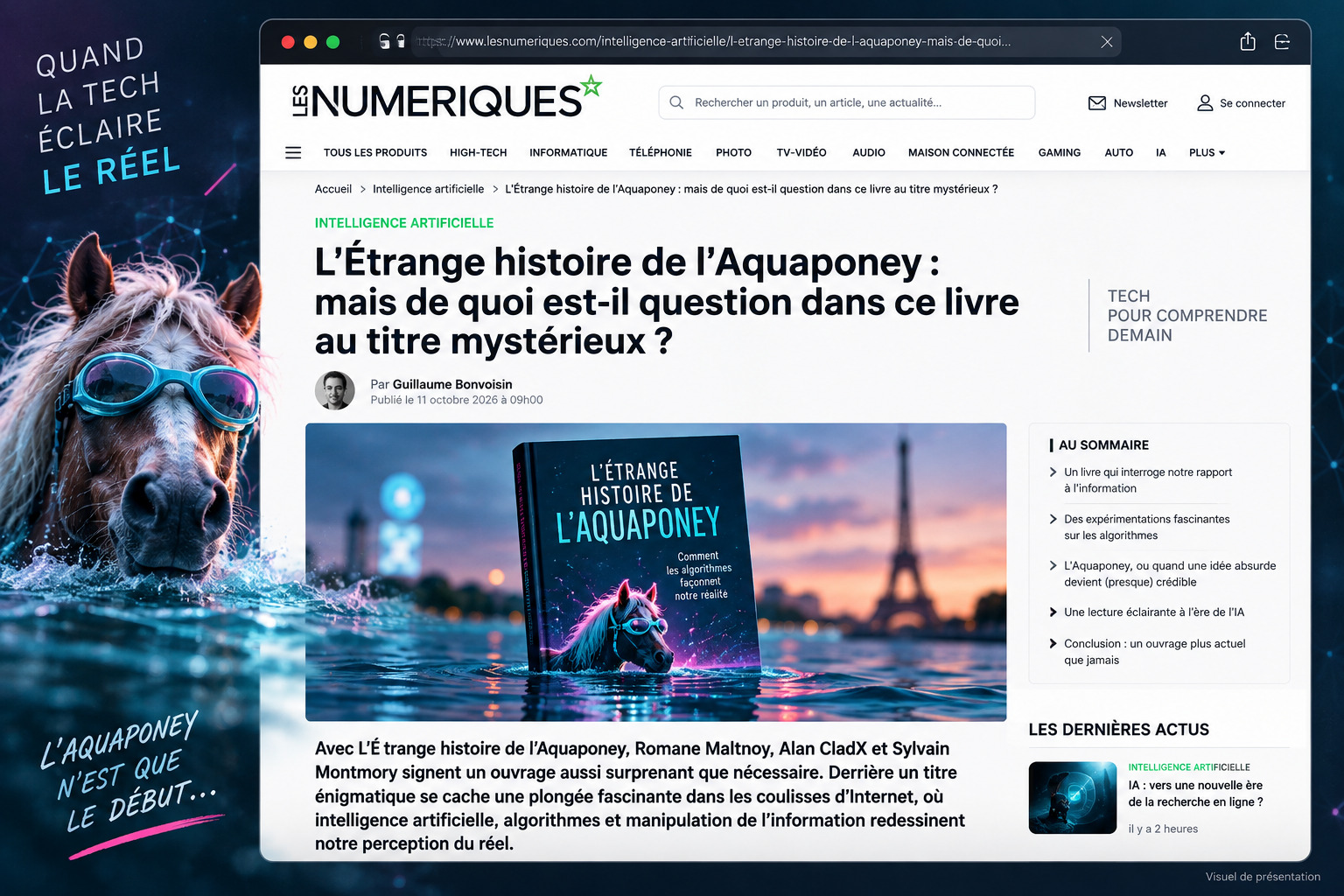
Les Numériques features an article on The Strange Story of the Aquaponey: Alan CladX, AI, algorithm manipulation, and the web's behind-the-scenes.
We wanted to discuss artificial intelligence, algorithm manipulation, bots, and how the Internet is gradually becoming a massive machine producing artificial truths.
We called it The Strange Story of the Aquaponey.
And apparently, the title works.
On October 11, 2026, Les Numériques, one of France's leading tech media outlets, dedicated an article to our book, written by journalist Guillaume Bonvoisin.
The title? The Strange Story of the Aquaponey: what is this mysteriously titled book about?
Spoiler: it’s not a manual on how to swim with a pony.
When Les Numériques uncovers the web’s backstage
What pleased me most about this publication is not just that a media outlet talks about our book.
It’s that the journalist truly took the time to read it, explore its mechanisms, and understand its stakes.
Even for someone already familiar with the web’s backstage, some revelations seem to have made an impact.
Guillaume Bonvoisin notably writes:
“Yet, this work made me truly aware of the scale of the phenomenon.”
That’s exactly one of the project’s goals.
With Romane Maltnoy and Sylvain Montmory, we wanted to show what really happens behind the screens, beyond marketing speeches about an AI supposedly revolutionizing the world.
Reality is sometimes much less glamorous.
Bots, AI, fake reviews: welcome to the real Internet
The Les Numériques article covers several key topics from the book:
- Bots, which represent a significant share of web activity, sometimes for manipulation purposes.
- Generative artificial intelligence, which can recycle its own content and amplify errors.
- Fake reviews and social networks, where popularity and authenticity don’t necessarily go hand in hand.
- Search engines, whose AI-generated answers disrupt publishers’ economic models.
- Information manipulation, capable of turning a carefully spread absurdity into an alleged reality.
One passage amused me particularly: the one about “algorithmic cannibalism.”
One AI produces content. Another AI retrieves it. A third learns from it. Gradually, machines feed on what other machines have invented.
At what point does information become true simply because it’s been repeated enough times?
This question has fascinated me for years, especially through my experiments with search engines and large language models.
The Aquaponey: a joke turned demonstration
Of course, it’s impossible to talk about this book without mentioning the Aquaponey.
For those discovering the story, the Aquaponey became an experimental ground around a simple question:
Can we convince search engines and artificial intelligences that an absurd invention is reality?
By multiplying signals, references, and content, it’s possible to influence how some automated systems interpret information.
The story of the Aquaponey and its alleged presence at the Paris Olympic Games is a deliberately grotesque illustration.
But behind the humor lies a serious problem.
If we can create artificial credibility around an improbable sport, what about far more sensitive subjects?
A person’s reputation? A company? A historical event? Political information?
That’s precisely what we aim to make people understand.
A human book about an increasingly inhuman Internet
Another detail noted by Les Numériques: The Strange Story of the Aquaponey is a book written by a human.
At a time when it’s possible to produce thousands of pages with a few prompts, this distinction almost deserves to be displayed on the cover.
The book, written by Romane Maltnoy with forewords by Sylvain Montmory and myself, blends analysis, data, cultural references, humor, and experiments.
It’s not a manual to become an AI expert in five minutes.
It’s an invitation to see the Internet differently.
And I’m particularly glad Les Numériques also highlighted the book’s narrative structure, up to its final surprise.
No spoilers here.
Thanks to Les Numériques, and welcome to the rabbit hole
A big thank you to Guillaume Bonvoisin and the Les Numériques editorial team for this in-depth reading and article.
Seeing our work presented from this angle, with genuine reflection on AI’s consequences, synthetic content, and the web’s future, is especially gratifying.
And above all, it helps bring these issues to a wider audience.
Because the challenge is not just whether ChatGPT can say anything.
The challenge is understanding who controls the information on which artificial intelligences build their answers.
And believe me, that’s far more interesting than a pony race in a pool.
We called it The Strange Story of the Aquaponey.
And apparently, the title works.
On October 11, 2026, Les Numériques, one of France's leading tech media outlets, dedicated an article to our book, written by journalist Guillaume Bonvoisin.
The title? The Strange Story of the Aquaponey: what is this mysteriously titled book about?
Spoiler: it’s not a manual on how to swim with a pony.
When Les Numériques uncovers the web’s backstage
What pleased me most about this publication is not just that a media outlet talks about our book.
It’s that the journalist truly took the time to read it, explore its mechanisms, and understand its stakes.
Even for someone already familiar with the web’s backstage, some revelations seem to have made an impact.
Guillaume Bonvoisin notably writes:
“Yet, this work made me truly aware of the scale of the phenomenon.”
That’s exactly one of the project’s goals.
With Romane Maltnoy and Sylvain Montmory, we wanted to show what really happens behind the screens, beyond marketing speeches about an AI supposedly revolutionizing the world.
Reality is sometimes much less glamorous.
Bots, AI, fake reviews: welcome to the real Internet
The Les Numériques article covers several key topics from the book:
- Bots, which represent a significant share of web activity, sometimes for manipulation purposes.
- Generative artificial intelligence, which can recycle its own content and amplify errors.
- Fake reviews and social networks, where popularity and authenticity don’t necessarily go hand in hand.
- Search engines, whose AI-generated answers disrupt publishers’ economic models.
- Information manipulation, capable of turning a carefully spread absurdity into an alleged reality.
One passage amused me particularly: the one about “algorithmic cannibalism.”
One AI produces content. Another AI retrieves it. A third learns from it. Gradually, machines feed on what other machines have invented.
At what point does information become true simply because it’s been repeated enough times?
This question has fascinated me for years, especially through my experiments with search engines and large language models.
The Aquaponey: a joke turned demonstration
Of course, it’s impossible to talk about this book without mentioning the Aquaponey.
For those discovering the story, the Aquaponey became an experimental ground around a simple question:
Can we convince search engines and artificial intelligences that an absurd invention is reality?
By multiplying signals, references, and content, it’s possible to influence how some automated systems interpret information.
The story of the Aquaponey and its alleged presence at the Paris Olympic Games is a deliberately grotesque illustration.
But behind the humor lies a serious problem.
If we can create artificial credibility around an improbable sport, what about far more sensitive subjects?
A person’s reputation? A company? A historical event? Political information?
That’s precisely what we aim to make people understand.
A human book about an increasingly inhuman Internet
Another detail noted by Les Numériques: The Strange Story of the Aquaponey is a book written by a human.
At a time when it’s possible to produce thousands of pages with a few prompts, this distinction almost deserves to be displayed on the cover.
The book, written by Romane Maltnoy with forewords by Sylvain Montmory and myself, blends analysis, data, cultural references, humor, and experiments.
It’s not a manual to become an AI expert in five minutes.
It’s an invitation to see the Internet differently.
And I’m particularly glad Les Numériques also highlighted the book’s narrative structure, up to its final surprise.
No spoilers here.
Thanks to Les Numériques, and welcome to the rabbit hole
A big thank you to Guillaume Bonvoisin and the Les Numériques editorial team for this in-depth reading and article.
Seeing our work presented from this angle, with genuine reflection on AI’s consequences, synthetic content, and the web’s future, is especially gratifying.
And above all, it helps bring these issues to a wider audience.
Because the challenge is not just whether ChatGPT can say anything.
The challenge is understanding who controls the information on which artificial intelligences build their answers.
And believe me, that’s far more interesting than a pony race in a pool.
IMG_ARCHIVE
1 files
/root/classified/seo-conferences-media/les-numeriques-covers-our-book-aquaponey-cladx-292/